Sequential Methods: an Introduction
Repeated analyses of accumulating data with control of type I and type II errors
Clinical trials and epidemiological studies collect their data over months or years. It is natural — and often an ethical obligation — to look at the results before the end. Looking repeatedly, however, changes the error rates of the analysis. Sequential methods plan those looks in advance so that the overall probability of a false positive stays at its nominal level, and so that the study still has the power it was designed for.
This tutorial introduces the main families of sequential methods. It is written for applied researchers — clinicians, epidemiologists, psychologists, students — who know the basics of hypothesis testing and want to design or monitor a sequential study. It accompanies jmsequential, a jamovi module that implements the methods described here.
“Sequential analysis” here means analysing the same study repeatedly as its data accumulate. It does not cover the analysis of biological sequences, nor time-series modelling.
A map of the methods
| Family | The question it answers | Typical setting | Page |
|---|---|---|---|
| Classical group sequential boundaries | Stop early at a few planned looks? | Confirmatory trials | Boundaries |
| Error-spending functions | Looks at unplanned numbers or times? | Trials with a monitoring committee | Alpha spending |
| Futility boundaries | Stop when success has become unlikely? | Any trial | Futility |
| Triangular tests | Smallest expected sample size, frequent looks | Trials, psychology | Triangular tests |
| Interim monitoring | Is continuing worthwhile? | Monitoring committees | Monitoring |
| Inference after stopping | Valid estimate, CI and p-value | Every sequential report | Inference |
| Sequential probability ratio tests | Decide as soon as evidence is decisive | Phase II, experiments | SPRT |
| MaxSPRT | Detect an excess of adverse events early | Vaccine and drug safety | MaxSPRT |
| Phase II multistage designs | Go / no-go on a response rate | Oncology phase II | Phase II |
| Biomarker-stratified phase II | Go / no-go, and in which population | Targeted therapies | Biomarker phase II |
| Bayesian monitoring | Posterior or predictive statements at each look | Phase II, adaptive trials | Bayesian |
| Anytime-valid inference | Monitor continuously, no fixed horizon | A/B tests, living reviews | Anytime-valid |
Adaptive designs, trial sequential meta-analysis and CUSUM charts are summarised in Beyond this module.
How to read it
Start with the two Foundations pages: they explain why repeated looks need special treatment and introduce the one statistical structure that almost every method relies on. The other pages can then be read in any order. Each page gives the idea, the key formulas, an example, a box on how to do it in jmsequential, and its references. A glossary collects the vocabulary.
Notation
| Symbol | Meaning |
|---|---|
| \(\theta\) | treatment effect (difference in means, log hazard ratio, …); \(H_0\!: \theta = 0\) |
| \(\theta_1\) | effect the study is powered to detect |
| \(K\) | number of analyses (“looks”), \(k = 1, \dots, K\) |
| \(I_k\) | statistical information at look \(k\) (the inverse variance of \(\hat\theta_k\)) |
| \(t_k = I_k / I_K\) | information fraction |
| \(Z_k\) | standardised test statistic at look \(k\) |
| \(b_k\), \(a_k\) | efficacy and futility boundaries on the \(Z\) scale |
| \(\alpha\), \(\beta\) | type I and type II error rates; power \(= 1-\beta\) |
The examples are computed by the module
Every number and figure in the examples is computed live by jmsequential’s own engine, not copied from elsewhere. That engine was validated against the reference R packages rpact and gsDesign: 144 designs agree to within \(10^{-5}\) in boundaries and sample size. Code is hidden by default; click R code above any figure or table to see it.
Getting started in jamovi
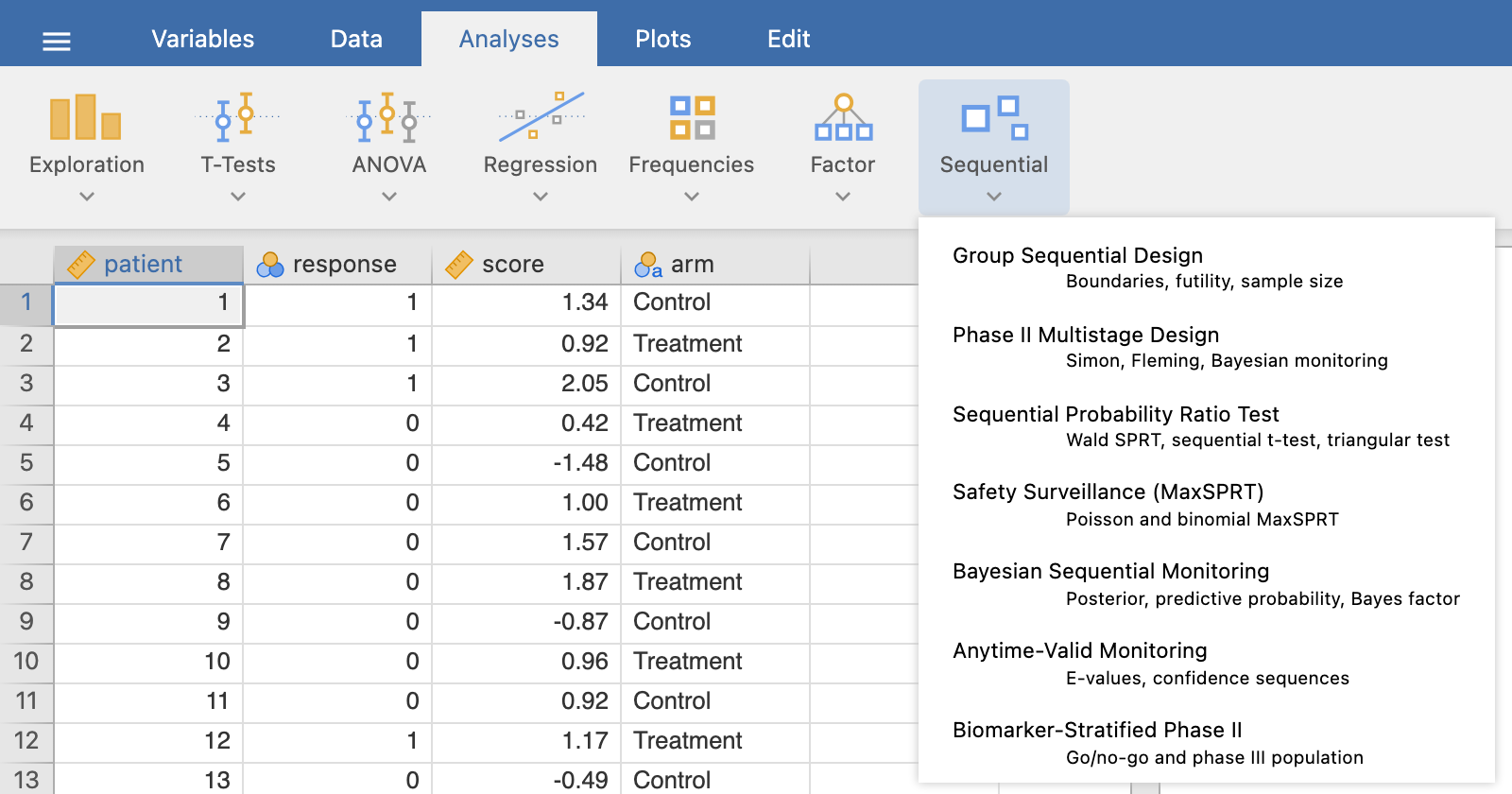
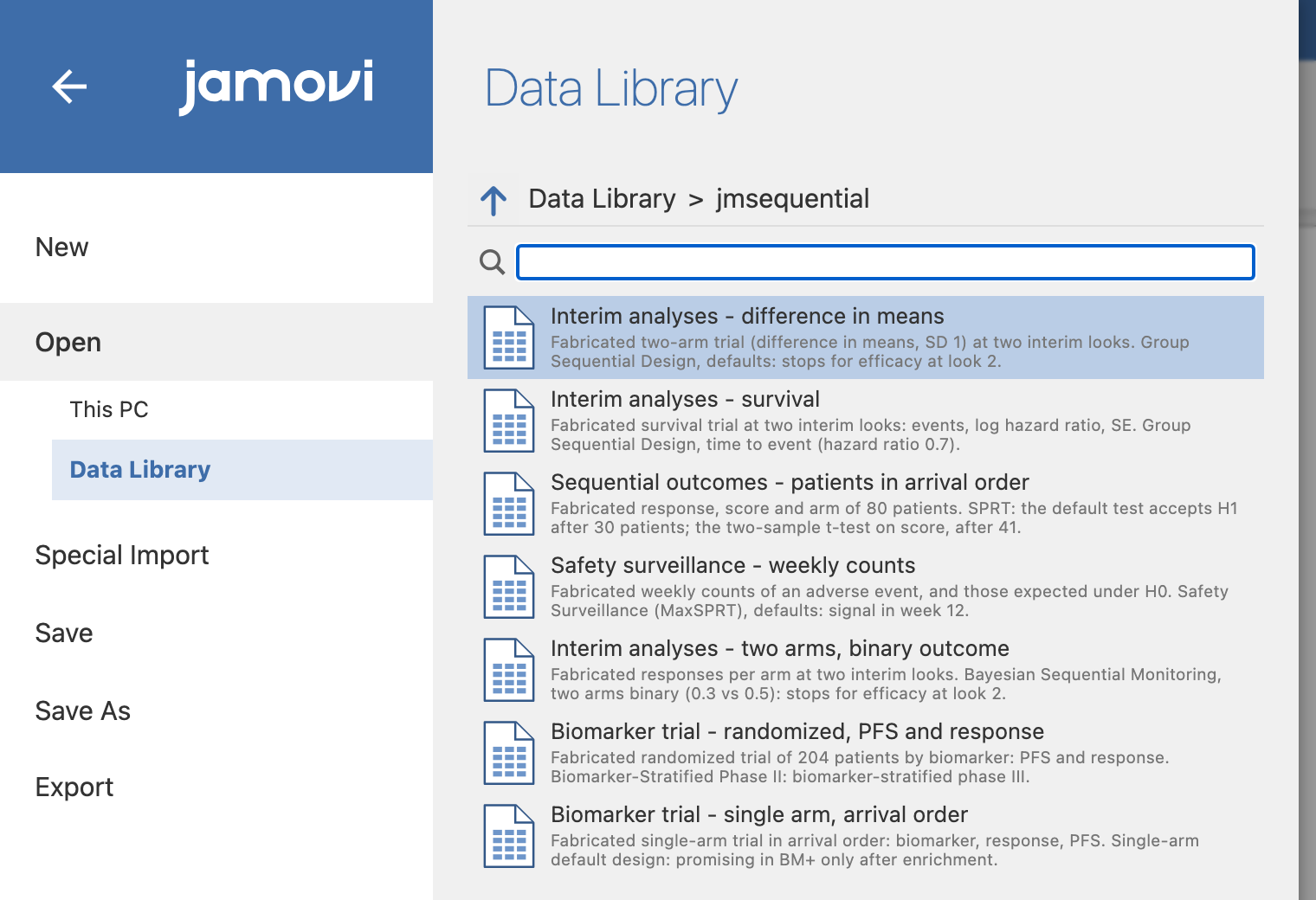
Install jmsequential in jamovi (Modules → jamovi library → Sideload, with the .jmo file of its release). Its analyses are then in the Sequential menu of the Analyses tab (Figure 1), and the example data sets of this tutorial come with it: ☰ → Open → Data Library → jmsequential (Figure 2). Each method page ends with its example worked in jamovi, with a screenshot of the options and the results; click a screenshot to enlarge it.
Module status
The tutorial grows with the module. Each method page gets its jamovi walk-through when the corresponding analysis is released. In jamovi every analysis of the Sequential menu offers the design first; the data go in the Analysis of observed data box at the end of its options, for interim monitoring or for the final analysis against the same design.
| Version | Analyses |
|---|---|
| 0.1.0 | Group sequential design: boundaries, spending, futility, triangular tests, sample size (including survival with accrual and follow-up), interim monitoring and inference after stopping. Phase II multistage designs: Simon, single-stage, Fleming, Bayesian predictive and posterior |
| 0.3.0 | Sequential probability ratio tests (Wald, sequential t-tests, continuous triangular test, truncation) and the MaxSPRT for safety surveillance (Poisson and binomial, continuous or group) |
| 0.5.0 | Bayesian monitoring (normal approximation, two arms binary, JZS Bayes factor) with exact or simulated frequentist operating characteristics; anytime-valid e-values and confidence sequences (mixture SPRT, safe t-test) |
| 0.6.0 | Individual-level data for interim analyses |